


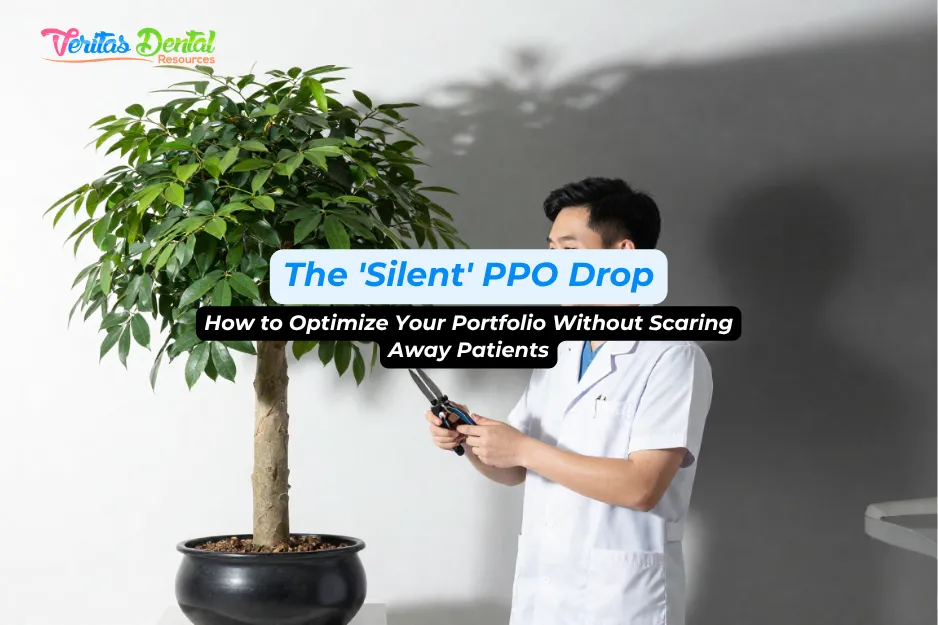
The 'Silent' PPO Drop: How to Optimize Your Portfolio Without Scaring Away Patients
You know the feeling. It’s that Sunday night pit in your stomach when you look at your schedule for the week. You’re booked solid, triple-booked, even, but you already know that by Friday, you’ll have worked 50 hours just to break even.
Why? Because half those patients are on a plan that pays you 2008 rates while you’re paying 2026 overhead.
You’ve thought about dropping that PPO. You’ve hovered your finger over the "cancel" button more times than you can count. But then the panic sets in. What if they all leave? What if the waiting room turns into a ghost town? What if my front desk person quits because they’re tired of being yelled at by Mrs. Higgins?
So, you stay. You keep grinding. You keep letting the insurance companies dictate the value of your clinical expertise.
Well, I’m here to tell you that the "mass exodus" is a myth designed to keep you submissive. At Veritas Dental Resources, we see it every day: practices that finally get fed up, drop the dead weight, and actually increase their net profit while working less.
The secret isn’t a loud, aggressive breakup. It’s the "Silent" PPO Drop. It’s about surgical precision, strategic portfolio optimization, and knowing exactly how to talk to your patients so they realize they’re loyal to you, not their insurance card.
The Myth of the "Silent" PPO (And the Reality of the Trap)
In the industry, a "Silent PPO" usually refers to a sneaky arrangement where a non-contracted payer hitches a ride on a contracted fee schedule without your permission. It’s a total scam. They get the discount; you get the shaft, and you don't even get the "benefit" of being listed in their directory.
Insurance Translation:
"We are optimizing our provider network to ensure patient access."
Real Meaning:
"We found a loophole to pay you 30% less for the same work, and we’re hoping you’re too busy doing root canals to notice the EOB."
But when we talk about a "Silent Drop," we’re talking about a different kind of strategy. We’re talking about identifying the plans that are leeching the life out of your practice and phasing them out so quietly and professionally that the "exodus" never happens.
Step 1: Stop Guessing and Start Auditing
Most dentists treat their PPO participation like a "set it and forget it" slow cooker. But that pot has been burning for years.
You cannot make a strategic move if you don’t know your numbers. We’re not just talking about your gross production; we’re talking about your net after the PPO write-offs. If a plan is asking for a 45% discount and your overhead is 65%, congratulations, you are literally paying for the privilege of working on that patient.
You need to audit your portfolio. Which plans are your "Top 3" losers? Which ones are hiding behind an umbrella network trap?
If you don't know which plans are actually hurting your bottom line, you're just throwing darts in the dark. You need to look at:
Effective Reimbursement Rates (The actual check you get vs. your UCR)
Chair-time utilization for that specific plan
The "Steerage" Factor (Is this plan actually sending you new patients, or are they just existing patients who switched jobs?)
Step 2: The "Silent" Part, Optimization Over Annihilation
The biggest mistake dentists make is trying to drop everything at once. That’s how you end up with a mutiny.
Instead, we look at Portfolio Optimization.
Maybe you don't need to drop every plan. Maybe you just need to drop the bottom 20%. Or maybe you need to negotiate your PPO fees for the ones you keep to offset the loss of the ones you drop.
Think of your practice like a high-end garden. If you never prune the weeds, the roses never bloom. The "Silent Drop" is a pruning process. You identify the least profitable, most administrative-heavy plans and you let them go first.
Step 3: Managing the "Mrs. Higgins" Factor (Patient Communication)
This is where the fear lives. You’re worried about the conversation.
"Doctor, why don't you take my insurance anymore? Is it because you bought a new Tesla?"
Nope: it’s because the insurance company hasn’t raised their rates in fifteen years while the cost of gloves, masks, and quality labs has tripled. But you don't say that. You don't make it about the money; you make it about the care.
Because at the end of the day, insurance doesn’t diagnose teeth: you do.
The "No-Panic" Script:
"Mrs. Higgins, we value you as a patient. To continue providing the high level of technology and specialized care you’ve come to expect from us, we’ve decided to change our relationship with [Insurance Carrier X]. While we are no longer 'in-network,' we are absolutely still seeing patients with your plan. We’ll still file all the paperwork for you, and in many cases, the difference in your out-of-pocket is minimal."
Spoiler: Most patients have no idea how their insurance works. They think if you aren't "in-network," they aren't allowed to come to you. When you frame it as "we're choosing quality over insurance company red tape," you'd be surprised how many stay.
Step 4: Expecting (and Welcoming) a Little Churn
Let’s be real: You will lose some patients.
But here’s the kicker: The patients you lose are almost always the ones who are "plan-loyal," not "practice-loyal." They are the ones who hunt for the cheapest cleaning and complain about a $10 copay.
By losing the bottom 10% of your patient base (the ones who cost you the most in administrative headaches and provide the lowest profit), you open up chair time for patients who actually value your work.
Imagine seeing 15% fewer patients but taking home 20% more money. That’s not a dream; that’s math.
Why Doing it Alone is a Recipe for Burnout
Can you do this yourself? Sure. You could also do your own plumbing, but you'd probably end up with a flooded basement and a headache.
The insurance companies have billion-dollar AI machines designed to find ways to deny your claims (we even wrote about how to fight those AI denial machines). They have teams of lawyers writing "LEAT" clauses that let them substitute your high-quality crown for a piece of tin if they feel like it.
You’re a dentist. You should be focused on clinical excellence, not arguing with a 22-year-old at a call center about why a buildup was necessary.
At Veritas Dental Resources, we act as your shield and your strategist. We know the CAQH credentialing mistakes that are holding you back. We know how to spot the "Silent PPO" discounts that are draining your bank account without your knowledge.
The Veritas Angle: It’s Time to Fight Back
We’re a little rebellious here. We’re tired of seeing great doctors burned out and ready to quit because they’re being squeezed by corporate greed.
Optimizing your portfolio isn't just about "dropping insurance." It's about taking back the steering wheel of your own practice. It’s about deciding that you determine the value of your time, not a spreadsheet in a corporate office in Connecticut.
If you’re tired of the PPO grind and you’re ready to see what your practice could look like if it were optimized for profit instead of volume, let's talk.
Final Thought: The Mic Drop
You didn't go to dental school for four years (and take on all that debt) to be a high-volume, low-margin technician for an insurance company.
The fear of dropping a PPO is the only thing keeping you from the practice you actually wanted when you started. The "Silent Drop" isn't just a strategy: it's your path to freedom.
Stop asking for permission to be profitable. Claim what’s yours.
Ready to see which PPOs are holding you back? Book a consultation with our team today and let's start pruning those weeds.
Benjamin Tuinei
Founder – Veritas Dental Resources, LLC
📞 888-808-4513
Services: PPO Fee Negotiators, PPO Fee Negotiating, Insurance Fee Negotiating, Insurance Credentialing, Insurance Verifications
Websites: www.VeritasDentalResources.com, www.VerusDental.com


