

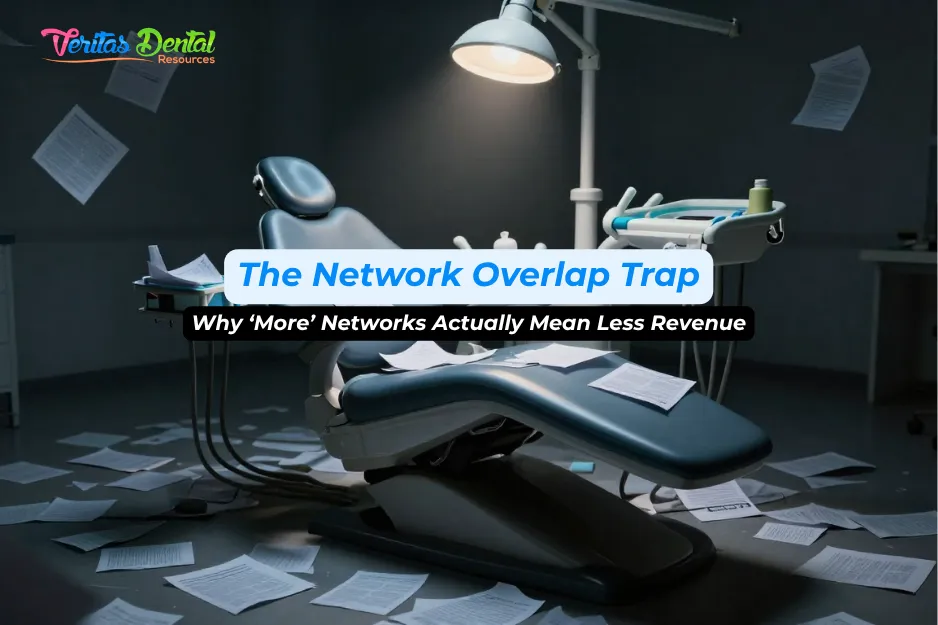
The Network Overlap Trap: Why ‘More’ Networks Actually Mean Less Revenue
You’ve been told the biggest lie in dentistry: “If you build it, and sign every PPO contract that crosses your desk, they will come, and you’ll be rich.”
It sounds logical, right? More networks mean more patients. More patients mean more chairs filled. More chairs filled means more production. And more production, well, that’s supposed to mean more money in your pocket.
Spoiler: It doesn’t.
In fact, for many practices, the "more is better" strategy is the fastest way to work yourself into an early retirement, not because you’re wealthy, but because you’re burned out from running a high-volume, low-profit treadmill.
At Veritas Dental Resources, we see it every single day. A practice owner calls us, frustrated because their schedule is packed, their team is exhausted, but their net profit is stagnant. When we dig into the numbers, we find the culprit: The Network Overlap Trap.
The Myth of the "Open Chair"
The fear of an empty chair is a powerful motivator. It’s the reason dentists sign up for every obscure PPO, every "discount" plan, and every umbrella network under the sun. You think you’re casting a wider net. You think you’re being "accessible."
But here’s the kicker: You aren’t just inviting more patients in, you’re inviting insurance companies to decide which of your many contracts pays the least.
When you join "Network A" and "Network B," and then sign an "Umbrella Agreement C" that leases out access to both, you’ve created a web of overlapping agreements. And in the world of dental insurance, when two or more contracts overlap, the house always wins.
Insurance Speak Translation:
"We leverage our vast network of partners to ensure your practice has maximum visibility to a diverse patient base."The Real Meaning:
"We’re going to let fifteen other insurance companies use our absolute lowest fee schedule to pay you for a crown, even if you have a direct contract with them that pays $200 more."
What Exactly is the Network Overlap Trap?
The trap is built on the back of "Leasing Agreements" and "Umbrella Networks." You might think you have a direct relationship with a major carrier, but that carrier might also be a part of a larger leasing network (like Connection Dental or Zelis).
When a patient walks in, the insurance company’s software doesn't look for the contract that is "fair" or "recent." It performs a digital search for the lowest allowable fee across every network you participate in.
If you are "In-Network" with a carrier through three different paths, the system defaults to the cheapest one. Every. Single. Time.
The "Invisible" Write-Offs Hidden in the Fine Print
This is where the controlled frustration sets in. You look at your EOBs and see write-offs that make your eyes water. But have you ever stopped to ask why that write-off is so high?
Most practices just shrug and say, "That’s just what the PPO pays."
Nope, it’s not.
It’s what the PPO gets away with paying you because your contracts are tangled. These are what we call "Invisible Write-offs." They aren't explicitly labeled as "The amount we saved by ignoring your better contract." They are hidden in the fine print of agreements you signed five years ago and haven't looked at since.
By joining "everything," you’ve essentially given insurance companies a "Get Out of Paying Fair Rates Free" card. You’ve surrendered your leverage in exchange for the hope of more patients, not realizing that you’re likely seeing the exact same patients you would have seen anyway, just for 20% to 30% less revenue.
The Race to the Bottom: How the Default Works
Let’s look at a hypothetical (but very real) scenario:
Direct Contract: You have a direct contract with Carrier X. Their fee for a D2740 (Crown) is $950.
Umbrella Network: You also joined an umbrella network three years ago because a salesman told you it would "fill your schedule." Their fee for the same crown is $720.
The Overlap: Carrier X is a "partner" with that umbrella network.
When you submit the claim for Carrier X, their system sees both. Does it pay the $950 you negotiated? Of course not. It sees you are "available" at $720 through the umbrella.
Boom. You just lost $230. Multiply that by 40 crowns a month. That’s $9,200 a month in pure profit vanishing into thin air because of a single overlapping contract.
And the worst part? You’re doing the same work, using the same materials, and paying the same staff. The only thing that changed is the insurance company’s ability to exploit your lack of strategic network leverage.
Why "More" Actually Means Less
When you have too many overlapping networks, your administrative overhead skyrockets. Your front desk team spends half their day on the phone trying to figure out which fee schedule applies to which patient.
Credentialing Nightmares: Managing 15 different credentialing portals is a recipe for costly mistakes.
Billing Confusion: Your team is constantly fighting denials and "incorrect payment" amounts that are actually just the system defaulting to a lower leased rate.
Profit Margin Erosion: As inflation drives up your cost of supplies and labor, your fixed PPO rates, especially the low-tier ones, are effectively a pay cut every year.
Because you’re so busy seeing "more" patients to cover the costs, you don't have time to sit down and analyze which networks are actually profitable. You’re in survival mode, and survival mode is exactly where the insurance companies want you.
The Veritas Angle: Untangling the Web
This is where we come in. At Veritas Dental Resources, we don’t just "negotiate fees." Anyone can send a letter asking for more money (and most will get a polite "no" in return).
We are detectives. We go into the "basement" of your practice’s insurance history and find those old, dusty umbrella agreements that are dragging down your revenue. We untangle the web of leasing arrangements to ensure that when a patient walks in, you are paid on the highest possible schedule available, not the lowest.
We help practices realize that less can be more.
Imagine dropping the three worst-paying networks in your practice. You might lose 5% of your patient volume, but if the remaining 95% of your patients are now being processed through higher-paying, direct contracts, your net revenue actually increases.
You work less. You make more. Your team stops wanting to quit every Monday morning.
Stop Being the Underdog
Insurance companies spend billions on algorithms designed to find the cheapest way to pay you. They have rooms full of data scientists working to ensure their strategies stay profitable for them.
Why are you fighting that system alone?
It’s time to stop burned sage and offering up prayers to the insurance gods, hoping for a fair check. It’s time to take control of your revenue. You are the one providing the care. You are the one taking the clinical risk. You deserve to be paid based on the highest contract you’ve earned, not the lowest one they can find.
How to Start Fighting Back
Audit Your Participation: Do you actually know every network you are "in" through leasing? (Hint: You probably don't).
Map the Overlaps: Look at your top five carriers and see if you are being paid different rates for the same codes under different "plans."
Be Strategic, Not Desperate: Stop signing contracts just because they are put in front of you.
Get Expert Eyes on Your Contracts: You wouldn’t let a patient perform their own root canal. Don’t try to perform your own PPO negotiation and optimization.
The "Network Overlap Trap" is real, it’s pervasive, and it’s costing you more than you realize. But it’s also beatable.
You don't need more networks. You need better ones. You need a strategy that prioritizes your profit over the insurance company’s bottom line.
Ready to see how deep your trap goes? Let's untangle it together.
Because at the end of the day, you should be running your practice, not letting a leased network agreement from 2014 run it for you.
The game is rigged, but only if you don't know the rules. Now you do.
Want to stop the "invisible" write-offs? Book a consultation with Veritas Dental Resources today and let’s get your revenue back on track.
Benjamin Tuinei
Founder – Veritas Dental Resources, LLC
📞 888-808-4513
Services: PPO Fee Negotiators, PPO Fee Negotiating, Insurance Fee Negotiating, Insurance Credentialing, Insurance Verifications
Websites: www.VeritasDentalResources.com, www.VerusDental.com


