


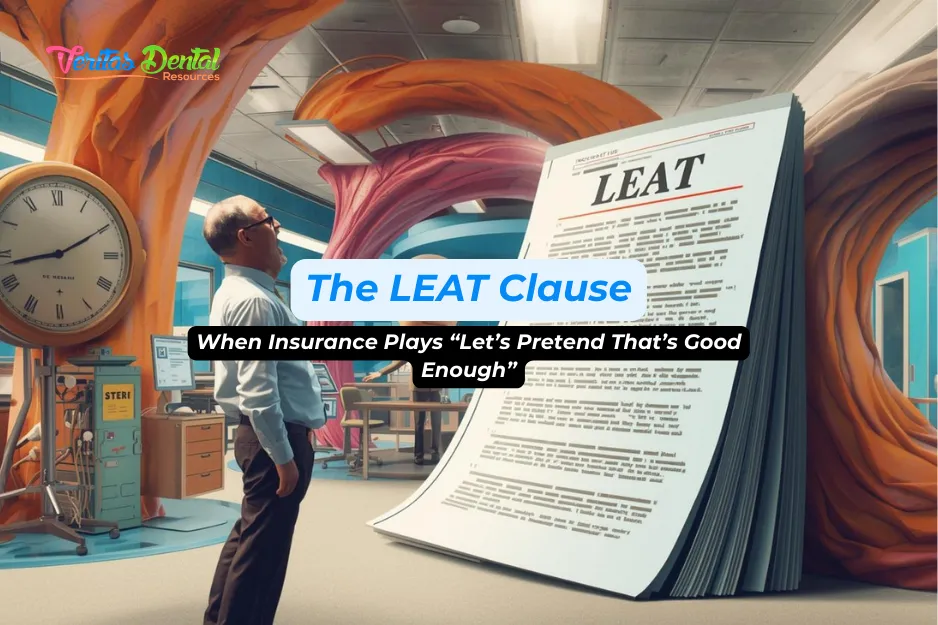
The LEAT Clause: When Insurance Plays “Let’s Pretend That’s Good Enough”
If you’ve been in dentistry longer than five minutes, you’ve probably met one of the most frustrating characters in the insurance world:
LEAT (Least Expensive Alternative Treatment).
It sounds harmless. Responsible. Even practical.
It’s not.
LEAT is the fine print that allows an insurance company to say:
“You recommended a crown… but we’ll pay for a filling.”
“You treatment planned a bridge… but we think a removable partial is ‘good enough.’”
Translation?
“We’ve decided the cheapest option is now the standard of care.”
And just like that, your comprehensive diagnosis gets downgraded by someone who has never seen the patient, never probed the tooth, and never had to look that patient in the eye.
Why LEAT Creates Chaos in Your Practice
When LEAT hits, it’s not just about money.
It triggers a three alarm fire in your office:
The Financial Gap
The patient is suddenly staring at an unexpected balance.
“They said it was covered…”
Now your front desk becomes a crisis management team.
The Trust Gap
“Why didn’t my insurance cover what the doctor said I needed?”
Suddenly, you look like the bad guy, when in reality you recommended the treatment that protects their long term health.
The Administrative Black Hole
Appeals. Narratives. Phone calls. More appeals.
Hours of your team’s time for reimbursement that may never come.
And here’s the part that stings:
Insurance didn’t practice dentistry in your operatory.
But they’re trying to dictate it.
The Strategic Pivot (Because You’re Not Powerless)
Here’s where things change.
You don’t just accept the downgrade.
Audit Your Narratives
Generic documentation feeds the LEAT machine.
Instead of:
“Tooth fractured. Crown recommended.”
Try:
“Tooth #19 presents with >50% structural compromise, vertical fracture lines, prior endodontic therapy, and insufficient remaining cuspal support. Direct restoration would not provide long term structural integrity.”
Make it crystal clear why the “least expensive alternative” is clinically inappropriate for this specific patient.
Because LEAT falls apart when the alternative is provably nonviable.
Educate Patients Before the Claim Is Sent
This might be the most powerful move of all.
Tell them upfront:
“Your insurance sometimes applies something called a Least Expensive Alternative Treatment clause. That means they may pay toward a cheaper option, even if it’s not what’s best for you. If that happens, we’ll help you understand it, but our recommendation won’t change.”
Now when the downgrade happens, it’s not a surprise.
It’s confirmation of what you already prepared them for.
That preserves trust.
The Bigger Truth
LEAT isn’t about clinical standards.
It’s about cost containment.
And if we’re not careful, it slowly trains practices to shrink their recommendations to match reimbursement instead of matching biology.
That’s the real danger.
You worked too hard for your training, your experience, and your diagnostic ability to let a spreadsheet decide the standard of care in your chair.
So let’s talk:
Has your practice been hit by LEAT downgrades lately?
How are you fighting back, stronger narratives, better patient education, strategic appeals?
Because one thing is certain:
Insurance companies may write the clause…
But they don’t get to write your clinical philosophy.
Benjamin Tuinei
Founder – Veritas Dental Resources, LLC
888-808-4513
Services: PPO Fee Negotiators, PPO Fee Negotiating, Insurance Fee Negotiating, Insurance Credentialing, Insurance Verifications
Websites: www.VeritasDentalResources.com, www.VerusDental.com


