


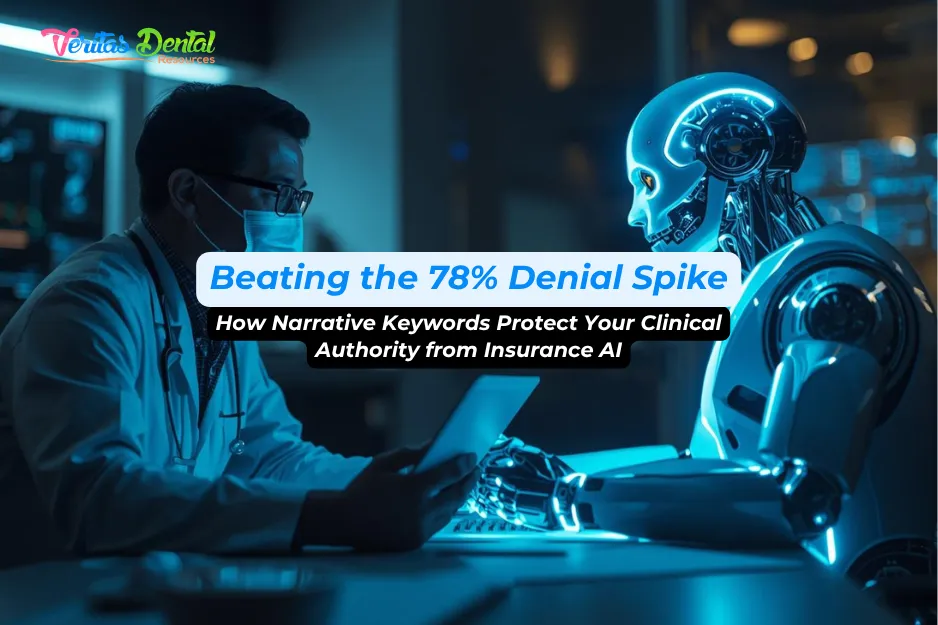
Beating the 78% Denial Spike: How Narrative Keywords Protect Your Clinical Authority from Insurance AI
Your clinical judgment is being overridden by a robot that’s never seen a tooth.
Let that sink in for a second. You spent years in dental school, hundreds of thousands of dollars on education, and decades refining your chairside intuition. You can spot a hairline fracture from across the room. You know when a tooth is failing before the patient even feels the first zing of pain.
But to the insurance company? Your expertise is a line item. And lately, that line item is getting hit with a "Denied" stamp at a rate we’ve never seen before.
We’re currently witnessing a massive 78% spike in insurance denials. This isn't a coincidence, and it’s not because doctors suddenly forgot how to diagnose. It’s because the insurance industry has handed the keys to the kingdom over to AI and low-level clerks trained to find any excuse to say "no."
At Veritas Dental Resources, we see the carnage every day. We see brilliant clinicians questioning their own notes because a spreadsheet told them a procedure wasn't "medically necessary."
Spoiler: The machine doesn't care about the patient’s pain. It only cares about the terminology.
The Rise of the Machine (and the Fall of Common Sense)
In the old days, you know, three years ago, a human being might actually look at your X-ray. Today? An algorithm hunts for specific clinical keywords. If your narrative doesn’t match the machine's "approved" list, it’s an automatic rejection.
Insurance companies are using AI to scan thousands of claims per second. These programs aren't looking for clinical truth; they are looking for omissions. They are looking for the one missing word that allows them to keep their money in their pockets instead of yours.
It’s a game of "Gotcha," and right now, the insurance companies are winning because they changed the rules without telling you. They’ve moved the goalposts so far back they’re in a different zip code. When you submit a claim, you aren't talking to a peer, you’re feeding a hungry algorithm that thrives on vague language.
As we've noted before, insurance doesn’t diagnose teeth, you do. But if you don't speak the "machine's language," your diagnosis might as well be written in invisible ink.
The "Broken Tooth" Trap
Let’s look at a classic example. You see a patient with a tooth that’s clearly seen better days. You write a narrative: "Patient has a broken tooth on #3. Recommending a crown."
In a sane world, that’s enough. The X-ray shows the break. The patient is in pain. The crown is the standard of care.
But in the world of the 78% denial spike? That narrative is a death sentence for the claim.
The Insurance Translation:
"Broken tooth? That’s vague. Was it a chip? Was it functional? Did they just want a pretty tooth? Denied. Reason: Lack of clinical necessity."
To beat the AI, you have to stop writing for humans and start writing for the "logic gates" of the software. Instead of "broken tooth," you need to use strategic narrative keywords like: "fracture including the cusp with loss of function."
See the difference?
Fracture sounds clinical and severe.
Including the cusp provides specific anatomical evidence.
Loss of function is the magic phrase that triggers "necessity."
If you aren't using this specific "armor" in your claims, you are essentially leaving your revenue to chance. You're falling for the half-pay shuffle where they pay for a filling when you performed a crown, simply because your words weren't "strong" enough to trigger the higher reimbursement.
Why "Wait and See" is a Financial Suicide Mission
Many practices see these denials and think, "We'll just appeal it."
Bad move.
Appeals take time. They take staff resources. They take money. While your office manager is on hold for forty-five minutes waiting to talk to a "representative" (who is likely reading from the same script the AI generated), your cash flow is bleeding out. This is what we call the invisible $11 leak, the administrative cost of chasing money you’ve already earned.
The insurance companies know that if they deny enough claims, a certain percentage of practices will simply give up. It’s a war of attrition. They are betting that you’re too busy treating patients to fight for that $800 crown reimbursement.
But when that 78% spike hits your practice, it isn't just one crown. It’s dozens. It’s your profitability for the entire quarter disappearing into a "system error."
Mastering the Strategic Narrative
To protect your clinical authority, you have to master the "Clinical Keyword Armor." Every narrative you send should be a bulletproof legal document.
Here are a few ways to pivot your language to satisfy the bots:
Stop saying "decay." Start saying "Carious involvement of the [specific surface] encroaching on the pulp" or "extensive decay with loss of structural integrity."
Stop saying "old filling." Start saying "Recurrent decay under existing restoration with marginal failure."
Stop saying "patient wants..." The patient’s desires are irrelevant to the AI. Focus entirely on the objective clinical need.
Reference the Manual. Insurance companies have their own rulebooks. If you don't know what's in them, you're playing poker with your cards facing out. We talk more about this in our breakdown of insurance manuals and how they deny claims.
The Veritas Angle: Building Your Practice's Armor
At Veritas Dental Resources, we don’t think you should have to become a linguist just to get paid for a crown. But we also know that the "rebellious" path is the only one that works. You can’t play nice with a system designed to exploit your silence.
We help practices build "armor" for their claims. We look at your revenue optimization from the ground up, ensuring that your narratives, your coding, and your clinical documentation are all aligned to force the insurance company’s hand.
We treat insurance optimization like a chess match. If the insurance company is going to use AI to find reasons to say "no," we are going to use our decades of expertise to give them every reason to say "yes."
It’s about taking back control. It’s about reminding these billion-dollar corporations that you are the doctor. They are the payer. Their job is to fulfill the contract, not to play doctor from a cubicle in another state.
Stop Letting the Spreadsheet Win
If you’ve noticed your "Pending" or "Denied" pile growing faster than your patient list, you aren't imagining things. You are caught in the middle of a systemic shift in how claims are processed.
The 78% spike is real. The AI is active. And your clinical judgment is under fire.
You can continue to write "broken tooth" and hope for the best, or you can arm your practice with a strategy that actually works in 2026. You can let the invisible insurance verification costs eat your lunch, or you can streamline your system to be bulletproof.
Don't let a robot dictate the value of your work. Your hands do the labor, your narratives should ensure you get the reward.
If you’re ready to stop the "Gotcha" games and start protecting your revenue, let's talk. Our team is ready to help you navigate this mess.
Check out our services or book a consultation to see how we can build your practice's armor.
Because at the end of the day, an insurance company might have the algorithm, but we have the truth. And it’s about time the truth started winning again.
Your clinical judgment shouldn't be dismissed by a spreadsheet, it should be the final word.
Benjamin Tuinei
Founder – Veritas Dental Resources, LLC
📞 888-808-4513
Services: PPO Fee Negotiators, PPO Fee Negotiating, Insurance Fee Negotiating, Insurance Credentialing, Insurance Verifications
Websites: www.VeritasDentalResources.com, www.VerusDental.com


