


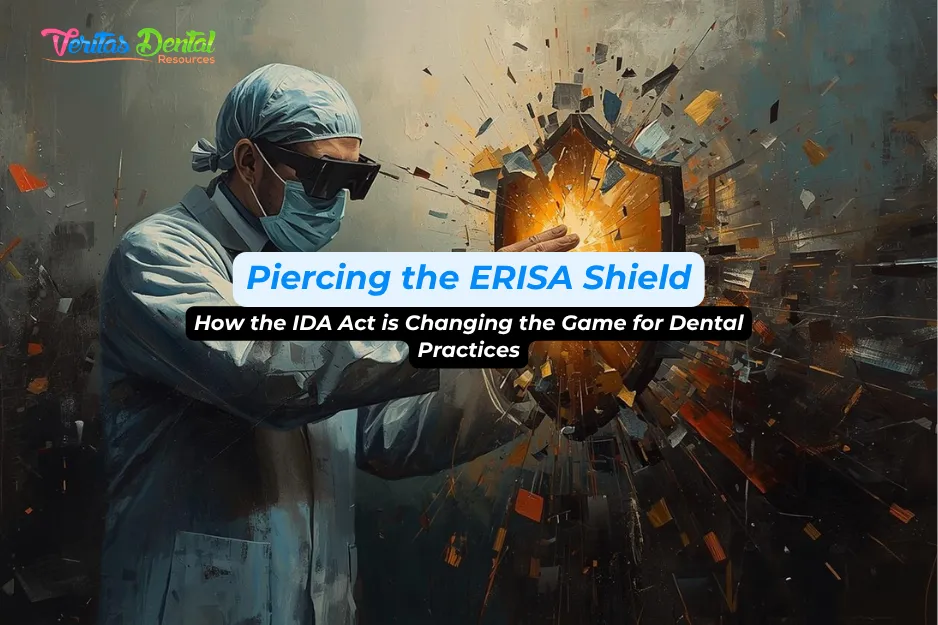
Piercing the ERISA Shield: How the IDA Act is Changing the Game for Dental Practices
You’ve seen the letter. You know the one. You submitted a clean claim for a crown, waited forty-five days, and finally received a denial or a delay notice that reads: “This plan is a self-funded plan governed by the Employee Retirement Income Security Act of 1974 (ERISA). As such, it is exempt from state insurance regulations.”
Translation: “We found a loophole, and we’re going to hide behind it so we don’t have to follow the rules everyone else does.”
For decades, dental insurance carriers have treated ERISA like a magical "Get Out of Jail Free" card. While state legislatures have worked hard to pass patient protection laws, things like prompt-pay requirements and bans on non-covered service price fixing, carriers have simply shrugged and pointed to the "ERISA Shield." They’ve effectively created a two-tiered system where your practice is held hostage by which federal or state bucket a patient’s employer falls into.
But the winds are shifting. On March 12, the Improving Dental Administration (IDA) Act (H.R. 7931) was introduced to the floor. If passed, it doesn’t just dent the ERISA shield, it shatters it.
At Veritas Dental Resources, we’ve spent years in the trenches helping practices fight back against carrier overreach. Today, we’re breaking down exactly how the IDA Act works, why ERISA has been such a thorn in your side, and what you need to do right now to prepare for this legislative earthquake.
The "ERISA Shield": A Masterclass in Regulatory Avoidance
To understand why the IDA Act is such a big deal, we have to look at the monster it’s trying to slay.
ERISA was originally designed in the 1970s to protect employee retirement funds and pensions. It was a noble goal. However, over the years, health and dental carriers realized they could use the "preemption clause" in ERISA to bypass state-level insurance laws.
Here is how the game is played: If an employer is large enough to "self-fund" their dental plan (meaning they pay for the claims themselves rather than paying premiums to an insurance company), that plan falls under federal ERISA jurisdiction. Because federal law is relatively silent on the nitty-gritty of dental claim processing, carriers have used that silence to do whatever they want.
Insurance Speak: "We are committed to following all applicable federal guidelines regarding plan administration."
The Translation: "There are almost no federal guidelines for dental claims, so we’re going to ignore your state's prompt-pay laws, ignore your state's ban on non-covered services, and lease your network out to three other companies without your permission. Because... federal law."
Because of this loophole, more than 360 state dental insurance reform laws passed over the last decade have been essentially toothless for nearly half of all dental enrollees. If your patient works for a major national corporation, odds are they are on an ERISA plan. And that means your state insurance commissioner is often powerless to help you when that carrier decides to play games.
Enter the IDA Act: The Sledgehammer to the Shield
The Improving Dental Administration (IDA) Act, spearheaded by Representatives Jeff Van Drew and Herb Conaway, is designed to end this "Two-Tiered" madness. It’s a targeted strike against the administrative chaos that carriers have profited from for years.
The IDA Act aims to bring transparency and parity to the industry by demanding that self-funded ERISA plans finally comply with the same standards we see at the state level. Here is how it’s changing the game:
Restoring State Regulatory Authority
The IDA Act seeks to allow state insurance departments to enforce patient protections across all plans, regardless of how they are funded. This means if your state has a law saying a carrier can’t dictate what you charge for a service they don't even cover, that law would actually apply to everyone. Imagine that, consistency.Standardization of Prompt Payments
Are you tired of "losing" claims in the mail or waiting 60 days for a "pending" status to resolve? The IDA Act pushes for standardized reimbursement policies. No more hiding behind federal silence to sit on your money for months at a time.Transparency in Network Leasing
This is a big one. We’ve seen countless practices find out they are "in-network" with a company they’ve never heard of because their primary carrier leased out their contract. The IDA Act targets these "silent PPOs" and demands transparency, giving you back control over who you actually have a contract with.
Why Carriers are Sweating (And Why You Should Be Cheering)
The reason carriers have fought so hard to keep the ERISA shield intact is simple, money.
When they don’t have to follow state laws, they can hold onto "float" (your money) longer. They can deny claims using internal "processing policies" that would never fly under state scrutiny. They can create administrative hurdles that are so exhausting most practices eventually just give up and write off the balance.
But at Veritas, we don’t believe in giving up. We believe in revenue optimization. We’ve seen the internal data. We know that when the playing field is leveled, practices thrive. The IDA Act isn't just about "administrative ease", it’s about the financial health of your business.
How Veritas Dental Resources Navigates the Battlefield
Navigating the intersection of federal ERISA law and state insurance reform isn't for the faint of heart. It requires a level of expertise that most office managers simply don't have the time to cultivate while they’re also trying to manage a schedule and talk to patients.
That’s where we come in. Benjamin Tuinei and the team at Veritas have built a reputation on being the "insiders" who know the carriers' playbooks better than they do.
We don’t just look at your fees, we look at the regulatory environment of your specific contracts.
Is your carrier claiming ERISA protection to avoid a state prompt-pay law?
Are they using a federal loophole to bundle codes like D7240 in a way that violates state standards?
Are you being underpaid because you haven't audited your PPO enrollment in years?
We specialize in "Piercing the Shield" ourselves by holding carriers accountable to the laws that do exist and preparing you for the ones that are coming. Whether it's through dental insurance verification services or deep-dive contract analysis, we provide the tactical support you need to win.
Action Plan: Prepare for the Shift
The IDA Act is a massive step forward, but you shouldn't wait for a bill to be signed to start protecting your practice. The "ERISA Shield" is already starting to crack under the weight of public and professional pressure.
Here is what you need to do right now:
Audit Your Current Contracts
Do you actually know which of your contracts are state-regulated and which are ERISA-governed? Most practices have no idea. You need to know which battles you can win today and which ones will require the IDA Act to settle. Start by auditing your billing and coding to find the hidden leaks.Document the "Loophole" Denials
Start a folder. Every time a carrier denies a claim or ignores a state law by citing "ERISA Preemption," save it. This is your ammunition. When the IDA Act passes (or when you hire a consultant to fight for you), this documentation is the proof of the "administrative burden" that needs to be corrected.Review Your Network Participation
With the IDA Act targeting network leasing, now is the perfect time to see who you are actually contracted with. If you are being "leased out" without your consent, it’s time to re-evaluate those relationships. Check out our partner benefits to see how we help with this.Get Expert Eyes on Your Revenue Cycle
The insurance companies have teams of lawyers and actuaries working to keep your reimbursements low. You need someone in your corner who understands the game. Don't go into these federal vs. state battles alone.
The Bottom Line
For too long, the ERISA shield has been used to justify the unjustifiable. It has allowed multi-billion dollar carriers to treat dental practices like an interest-free loan department. The IDA Act represents a turning point, a moment where the "federal loophole" finally meets the reality of modern dental practice management.
But remember, the carriers won't just roll over. They will find new ways to obfuscate, new ways to delay, and new ways to protect their margins at your expense. You can either stay frustrated, or you can get strategic.
The game is changing. It’s time you learned the new rules.
Ready to see how these legislative shifts impact your specific practice? Don't wait for the mail to bring you another ERISA denial. Book a consultation with our team today and let’s start auditing your way to a more profitable future.
Because at the end of the day, the only thing that should be "shielded" in your office is your patients' health (not the insurance carrier's bottom line.)
Benjamin Tuinei
Founder – Veritas Dental Resources, LLC
📞 888-808-4513
Services: PPO Fee Negotiators, PPO Fee Negotiating, Insurance Fee Negotiating, Insurance Credentialing, Insurance Verifications
Websites: www.VeritasDentalResources.com, www.VerusDental.com


