


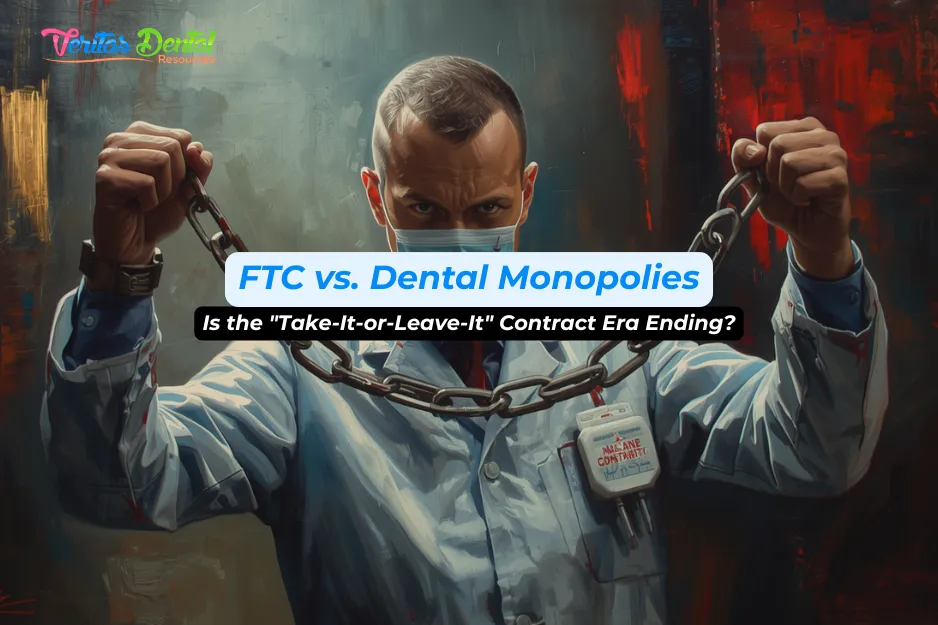
FTC vs. Dental Monopolies: Is the "Take-It-or-Leave-It" Contract Era Ending?
FTC vs. Dental Monopolies: Is the "Take-It-or-Leave-It" Contract Era Ending?
![[HERO] FTC vs. Dental Monopolies: Is the "Take-It-or-Leave-It" Contract Era Ending?](https://ci3.googleusercontent.com/meips/ADKq_NbSUihKd70fEn2erK7-GTLcK18BgoGqVr_I2EtAjQ4nbHkAsEASGljkFBlGwWcdU-Vi9220TGxJ9LnvZeMfzg=s0-d-e1-ft#https://cdn.marblism.com/l8Idk-JJt-j.webp "[HERO] FTC vs. Dental Monopolies: Is the \"Take-It-or-Leave-It\" Contract Era Ending?")
Ever feel like you’re running a non-profit you didn't actually sign up for? You spend years in dental school, hundreds of thousands in tuition, and decades honing your craft, only to have a massive insurance corporation tell you that your expertise is worth exactly what it was in 2004.
It’s the "take-it-or-leave-it" era. It’s that feeling of looking at a contract renewal and realizing you have zero leverage because one or two carriers own the entire market in your zip code. You either sign their soul-crushing terms, or you lose half your patient base overnight.
But here’s the kicker: The walls might finally be closing in on these insurance monopolies.
The American Dental Association (ADA) has officially urged the Federal Trade Commission (FTC) to take a long, hard look at the anticompetitive tactics of dental insurance giants. At Veritas Dental Resources, we’ve been in the trenches for years, watching these "games" play out. And if the FTC actually listens? Everything is about to change for your practice.
The "Get Out of Jail Free" Card is Expired
For decades, dental insurers lived in a legal fantasy land. Thanks to the McCarran-Ferguson Act of 1945, they enjoyed a massive antitrust exemption. While other industries had to play by the rules of fair competition, dental insurers could essentially huddle up, fix prices, and divide markets like kids trading baseball cards.
Spoiler: That party ended in 2021.
With the passage of the Competitive Health Insurance Reform Act (CHIRA), that "get out of jail free" card was shredded. Dental insurers are now subject to the same federal antitrust laws as everyone else. Price-fixing, bid-rigging, and market allocation are no longer just "business as usual", they are potentially illegal.
> Insurance Speak Translation:
> "Our reimbursement rates are based on regional market stability."
> What they actually mean:
> "We all agreed to pay you the same low rate so you have nowhere else to go. Good luck with that lease payment."
The ADA’s recent push to the FTC is the next logical step. They are pointing out that even though the law changed, the behavior hasn’t. These "take-it-or-leave-it" contracts are still the standard operating procedure, and it's time the FTC treated them like the monopolies they are.

How "Take-It-or-Leave-It" Traps Your Practice
If you’ve ever tried to negotiate your fees with a major carrier, you’ve probably heard some version of, "We don't negotiate with individual providers."
It’s a classic power move. They know they hold the keys to the patient pool. This monopoly-style leverage allows them to force practices into contracts that are, frankly, insulting.
Here is how they trap you:
Stagnant Fee Schedules: Some practices are literally working on fee schedules that haven't been updated in 15 years. Inflation has soared, the cost of PPE has tripled, and your lab fees are climbing, but the insurance company thinks $600 for a crown is still "fair."
Unfavorable Terms: Ever read the fine print? Many contracts allow the insurer to change terms unilaterally with just a 30-day notice. You’re locked in; they aren't.
The "Silent" PPO Trap: Through leased networks and umbrella agreements, insurance companies can shuffle your practice around like a piece of mail. You think you’re in-network with one company, but suddenly you’re getting paid at a lower rate by three others you never signed with.
It’s a system designed to make you feel powerless. But at Veritas Dental Resources, we know the "insurance games" better than the people who wrote the rulebook.
Fighting Back: The Veritas Strategy
You don’t have to wait for the FTC to finish their investigation to start reclaiming your revenue. While the government moves at the speed of a snail in a blizzard, you have a practice to run today.
We specialize in helping doctors level the playing field. We aren't just looking for a "win"; we're looking to fundamentally shift the power dynamic back to the provider. Here is how we do it:
1. Contract Optimization & Negotiation
Most doctors try to negotiate their own fees, get rejected once, and give up. We don't take "no" for an answer because we know which levers to pull. We analyze your current production, your local market data, and the insurer's actual participation rates to build a case they can’t ignore.
2. Leveraging Umbrella Networks
If the "front door" of direct negotiation is locked, we find the side door. Using PPO enrollment strategies and umbrella (leased) networks, we can often position your practice to receive higher reimbursements for the exact same procedures, simply by changing which "pipe" the claims flow through.

3. Knowing the Codes
Insurance companies love to play "hide the money" with specific codes. Whether it’s understanding D7240 or navigating the nuances of exam codes, knowing the technical side of billing is half the battle. If you don't code it right, they won't pay it right.
Why This Matters (Beyond the Bottom Line)
Let’s be real: This isn't just about the money. It’s about the quality of care.
When an insurance monopoly suppresses your fees, they are effectively putting a ceiling on the quality of dentistry you can provide. If you’re being reimbursed at 1998 levels, you’re forced to see more patients in less time just to keep the lights on. That’s how burnout happens. That’s how the "drill-and-fill" assembly line is born.
By reclaiming your revenue, you’re reclaiming your time. You’re giving yourself the margin to invest in better technology, higher-quality materials, and a team that isn't stressed to the breaking point.
> Mock Insurance Response:
> "But we provide your patients with access to affordable care!"
> Veritas Translation:
> "We provide your patients with a plastic card that gives them the illusion of coverage while we simultaneously make it impossible for their dentist to spend more than 10 minutes with them."

Is the Era Really Ending?
The short answer: Yes, but only if you’re willing to participate in the shift.
The legal landscape is finally in our favor. CHIRA is on the books. The ADA is barking at the FTC's door. Class-action lawsuits are being filed against giants like Delta Dental for their alleged cartel-like behavior. The "take-it-or-leave-it" era is under siege.
But the insurance companies aren't going to just hand over the keys to the vault. They are going to fight to maintain their margins until the very last second. That’s why you need a partner who understands the services required to navigate this mess.
At Veritas, we’ve helped thousands of practices move away from the "hope and pray" method of insurance management. We don't offer "tips"; we offer a comprehensive system to optimize your revenue so you can get back to being a doctor.
What Should You Do Now?
If you’re tired of being treated like an ATM for billion-dollar insurance companies, it’s time to take action. You don't have to navigate these monopolies alone.
Educate Your Team: Make sure your front office knows that "in-network" status isn't a static thing. It's a moving target.
Audit Your Contracts: When was the last time you actually read the terms you're operating under? (If you need a hand with that, we’re here).
Stop Accepting the Minimum: If you haven't seen a fee increase in three years, you aren't just "staying the same": you're losing money every single day due to inflation.
The FTC might eventually break up the monopolies. The DOJ might eventually enforce the new antitrust laws. But until then, the best defense is a strategic offense.
Let’s stop asking for permission to be paid fairly and start demanding it.
Ready to see what your practice is actually worth?
Don't wait for the government to save you. Take the first step toward reclaiming your practice’s independence and book a consultation with us today.
Because at the end of the day, you should be focused on your patients' smiles: not your insurance company's bottom line.
The "take-it-or-leave-it" era only ends when we stop taking it.
Want to learn more about how we help practices fight back? Check out our partner benefits or meet the team that's leading the charge.


