

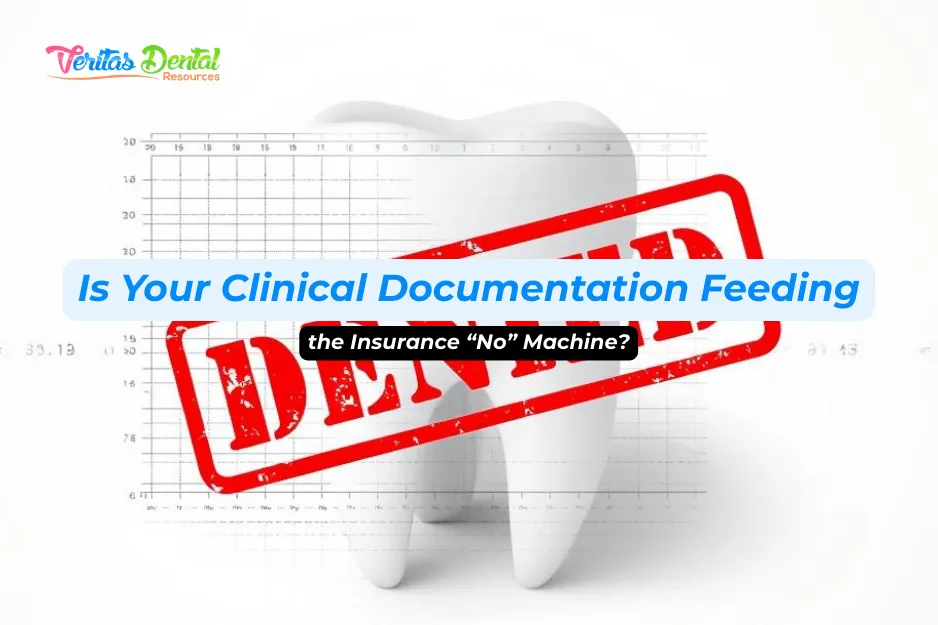
Is Your Clinical Documentation Feeding the Insurance “No” Machine?
Let’s talk about the quiet villain in your practice.
It’s not the hygienist who forgets to attach the perio chart.
It’s not the front desk who forgot to hit “resubmit.”
It’s not even the downgrade from D2740 to something that makes you question your life choices.
It’s the “No” Machine.
And if we’re being honest, sometimes we’re the ones feeding it.
The Denial Game Is Not Random
Insurance companies have turned denials into a science. Algorithms scan your claim looking for one thing:
“Is there enough documentation here to justify medical necessity based on our internal criteria?”
If your narrative simply says:
“Heavy calculus. SRP performed.”
You just handed the payer an easy “No.”
Because you described what you did.
You didn’t justify why you had to do it.
And that difference?
It’s thousands of dollars a month.
The “Medical Necessity” Trap
Here’s how it works.
The payer software scans for:
• Pocket depths
• Bleeding on probing
• Radiographic bone loss
• Clinical attachment loss
• Mobility
• Furcation involvement
• Failed restorations
• Fracture lines
• Recurrent decay margins
If it doesn’t see language that mirrors its criteria, it flags your claim.
Not because you’re wrong.
Not because the treatment wasn’t appropriate.
But because your narrative didn’t speak the language.
And the machine says, denied.
From Description to Justification
Let’s look at the difference.
Weak Narrative:
“Tooth #30 fractured. Crown recommended.”
Denial likely.
Strong Narrative:
“Tooth #30 presents with fractured mesiobuccal cusp, undermined enamel, recurrent decay beneath existing restoration, and loss of structural integrity. Full coverage restoration required to prevent further fracture and potential endodontic involvement.”
Now you’re speaking their language.
You’ve moved from:
Observation
to
Clinical justification tied to risk and prognosis.
That shift changes outcomes.
Your Narrative Is a Legal and Financial Safeguard
Here’s what most teams don’t realize.
Clinical documentation is not just charting.
It is:
• A compliance record
• A medico-legal defense
• A revenue protection system
• A negotiation tool
Every generic narrative increases write offs.
Every justified narrative increases clean claim rates.
And in 2026, with rising overhead and stagnant PPO fees, you cannot afford to donate revenue because your documentation was good enough.
Good enough feeds the machine.
The 3 Moves That Shut Down the “No” Machine
Move From Diagnostic to Justification
Don’t just list findings.
Tie findings to consequences.
Instead of:
“5–6mm pockets.”
Say:
“Generalized 5–6mm pocket depths with bleeding on probing and radiographic bone loss indicating active periodontal disease requiring nonsurgical periodontal therapy to arrest progression.”
Make the necessity undeniable.
Use Keywords That Trigger Approval
Insurance software looks for trigger phrases like:
• Radiographic evidence
• Active disease
• Loss of function
• Structural compromise
• Risk of pulpal involvement
• Failed existing restoration
• Recurrent decay
This isn’t gaming the system.
It’s speaking clearly within it.
If they’re using software to evaluate your care, your documentation needs to pass software standards.
Train Your Team to See Documentation as Revenue Protection
This doesn’t start in billing.
It starts in the op.
Doctors, hygienists, assistants, everyone must understand:
The narrative is the bridge between clinical excellence and reimbursement.
If the assistant writes generic notes
If the hygienist shortcuts language
If the doctor assumes the X-rays are enough
The claim becomes vulnerable.
And insurance companies love vulnerable claims.
Insurance Bullying Starts With Ambiguity
Most denials aren’t personal.
They’re procedural.
The payer looks for ambiguity.
If they find it, they exploit it.
When your documentation is tight, specific, and clinically justified, you remove ambiguity.
And suddenly, denials decrease.
Appeals succeed.
Write offs shrink.
This Is Bigger Than One Claim
At Veritas Dental Resources, we see it every week:
Practices fighting PPO contracts on one end
While unintentionally leaking revenue through weak documentation on the other.
You can negotiate a 15 to 25 percent fee increase.
But if your claims are being downcoded or denied because of vague narratives?
You’re giving it back.
Documentation is leverage.
Documentation is strategy.
Documentation is protection.
Final Thought
You spent years mastering clinical skill.
Don’t let a three-line generic narrative devalue it.
The insurance “No” machine only wins when we make it easy.
Speak their language.
Justify your care.
Protect your revenue.
Because your training, your diagnosis, and your expertise deserve more than a software-generated denial.
Benjamin Tuinei
Founder – Veritas Dental Resources, LLC
📞 888-808-4513
Services: PPO Fee Negotiators, PPO Fee Negotiating, Insurance Fee Negotiating, Insurance Credentialing, Insurance Verifications
Websites: www.VeritasDentalResources.com, www.VerusDental.com


