


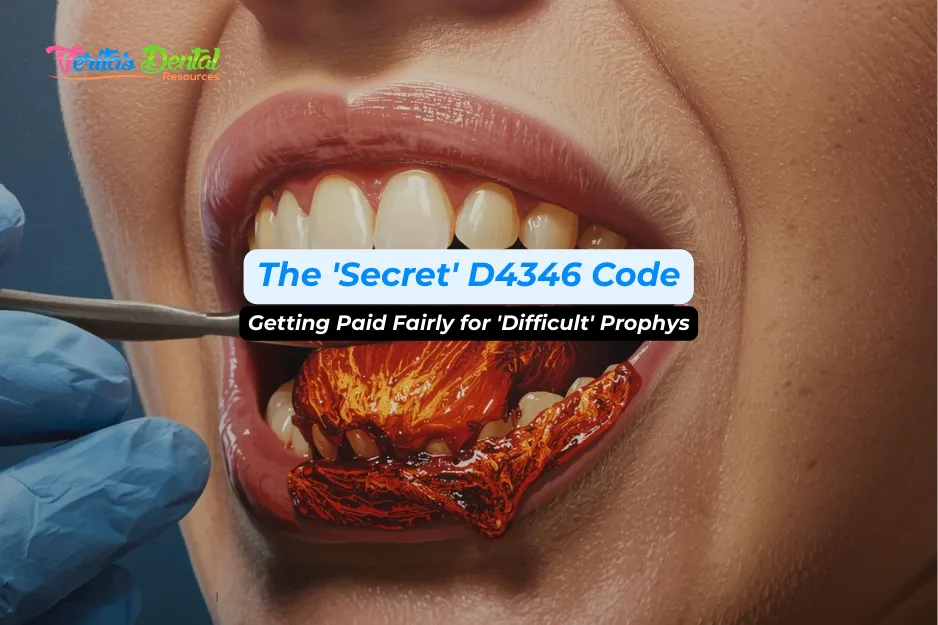
The 'Secret' D4346 Code: Getting Paid Fairly for 'Difficult' Prophys
We’ve all been there. You look at the schedule, see a "Standard Prophy" (D1110) blocked out for 60 minutes, and then the patient sits in the chair. You haven’t seen them in three years. Their gums are the color of a ripe tomato, and one gentle pass with the probe looks like a scene out of a slasher flick.
You spend the next hour sweating over a Cavitron, using every ounce of your clinical skill to navigate the "bloody prophy" from hell. By the time you’re done, your back hurts, your schedule is shot, and the office is going to collect a whopping $80 (if you’re lucky) from the insurance company.
It feels like a scam. Because, honestly? It kind of is.
For years, dental practices have been stuck in a clinical "no man's land." You have the healthy patients (D1110) and you have the patients with bone loss (Scaling and Root Planing - D4341/D4342). But what about the massive group of people stuck in the middle? The ones with heavy inflammation but no attachment loss?
Insurance companies would love for you to keep coding those as D1110s forever. Why? Because it’s cheaper for them. They want you to provide therapeutic-level work for preventive-level pay.
But there’s a way out. It’s called D4346.
The Great Insurance Gaslighting
If you feel like you’re working harder for less money every year, you’re not crazy. Insurance companies have spent decades conditioning us to believe that there are only two types of cleanings, the "easy" one and the "deep" one.
Insurance Translation:
"A D1110 is for anyone who doesn't have bone loss. We don't care if their mouth is a disaster zone of inflammation, if there’s no bone loss, it’s a prophy. Now get back to work and stop asking for more money."
Nope: I don't think so.
In 2017, the ADA finally gave us a weapon to fight back: D4346. Specifically, "Scaling in the presence of generalized moderate or severe gingival inflammation, full mouth, after oral evaluation."
It was designed specifically to bridge the gap between a routine cleaning and periodontal therapy. Yet, years later, so many offices are still terrified to use it. They’re afraid of the "D" word: Denials.
But here’s the kicker: If you aren't using D4346, you’re essentially giving away your expertise for free. You're letting the AI denial machines at the insurance companies win before you even submit the claim.
What D4346 Actually Is (and Isn't)
Let’s clear something up right now. D4346 is not a "difficult prophy" code.
If you try to bill D4346 just because a patient has a lot of plaque or because they’re a "chatty Cathy" who makes the appointment run long, you’re going to get denied faster than a credit card at a dive bar.
D4346 is a therapeutic code for a specific disease state. It’s not about how hard you worked, it’s about the clinical condition of the patient’s mouth.
To use this code legally and successfully, you have to hit three specific markers:
• Generalized Inflammation: This means the inflammation must involve more than 30% of the patient's teeth. Not 10%. Not "just the lower anteriors."
• Moderate to Severe: We’re talking swollen, red, "don't-even-look-at-it-or-it-will-bleed" gingiva.
• No Bone Loss: This is the big one. If there is radiographic bone loss or clinical attachment loss, you are likely looking at Periodontitis, which means you’re heading into SRP territory (D4341/D4342).
D4346 is for the patient who has a "full-blown gingivitis fire" going on in their mouth, but the "foundation" (the bone) is still intact.
Why the PPOs Want You to Ignore This
The profitability trap in modern dentistry is real. PPOs want to keep your fees suppressed while your overhead, labor, supplies, rent, continues to skyrocket.
When you perform a D4346 but code it as a D1110, you are participating in your own financial downfall. You are telling the insurance company, "My time and clinical expertise are only worth the minimum preventive fee, even when I’m treating active disease."
Stop it. Just stop.
When you use D4346 correctly, you aren't just getting paid more for that hour, you are properly diagnosing the patient. You are moving them from "preventive care" to "therapeutic care." That is a massive shift in the patient’s mind and in your clinical record.
The Documentation "Secret Sauce"
You already know the insurance companies are going to try to downcode this to a D1110. They’ll claim it "doesn't meet medical necessity" (which is just corporate-speak for "we don't want to pay this").
To beat them, you have to make your documentation so bulletproof that a denial would look like a legal liability for them.
• The 30% Rule: Your notes must explicitly state that the inflammation is generalized (more than 30% of the mouth).
• Bleeding Points: If you aren't recording bleeding on probing (BOP), you can forget about D4346. You need to show the map of the "fire" you’re trying to put out.
• Intraoral Photos: This is your silver bullet. A picture of angry, bulbous, bleeding gums is worth a thousand words, and about a hundred bucks in reimbursement.
• The Narrative: Don't just list the code. Write a short, punchy narrative: "Patient presents with generalized moderate-to-severe gingival inflammation (45% of sites). Heavy bleeding on probing. No radiographic bone loss. Procedure performed was therapeutic scaling to treat active gingivitis, not a preventive prophylaxis."
Talking to the Patient (Without Sounding Like a Salesman)
Hygienists often hesitate to use D4346 because they don't want to tell the patient it costs more than a "free" cleaning.
Spoiler: Nothing is free.
The conversation shouldn't be about the money, it should be about the health.
"Mrs. Jones, usually we do a preventive cleaning to keep your mouth healthy. But today, we’ve found that your gums are actually in an active state of infection. If we just do a regular cleaning, we’re essentially just polishing the top of a volcano. To actually treat this inflammation and get your mouth back to a healthy state, we need to do a therapeutic treatment today."
Most patients understand this. They feel the tenderness. They see the blood in the sink at home. When you frame it as treating an infection rather than "charging for a harder cleaning," the resistance disappears.
Bridging the Gap to SRP
Sometimes, a D4346 is the "litmus test" for a patient. You treat the generalized inflammation, and then you bring them back in 4-6 weeks for an evaluation.
If the tissue has healed and the bleeding is gone, great. They go back to a D1110.
If the inflammation subsides but you discover underlying bone loss that was previously obscured by the swelling, now you have a clear path to SRP.
This isn't about "gaming the system." It's about revenue optimization through clinical accuracy.
Stop Leaving Money on the Table
If you’re still letting PPO fee schedules dictate your clinical standards, you’re losing the battle. Whether it’s PPO negotiation mistakes or simply failing to use the codes available to you, the result is the same, your practice is bleeding out, just like that gingivitis patient’s gums.
D4346 isn't a "secret" code, but for many offices, it might as well be. It’s sitting right there in the CDT manual, waiting for you to use it to get paid fairly for the difficult, therapeutic work you’re already doing.
Is it more work to document? A little.
Is it a tougher conversation with the patient? Sometimes.
Is it worth it to stop being the insurance company’s doormat? Absolutely.
If you’re tired of the insurance games and want to learn how to actually take back control of your practice’s revenue, it’s time to stop guessing. Stop praying to the "insurance gods" and start using a strategy that actually works.
Let’s get your practice where it needs to be. Book a consultation with us today, and let’s look at how much money you’re actually leaving on the table.
Because at the end of the day, you’re a doctor, not a discount service provider. It’s time you started getting paid like one.
The insurance companies aren't going to give you a raise voluntarily. You have to take it. Reach out to our team and let’s start fighting back together.
Benjamin Tuinei
Founder – Veritas Dental Resources, LLC
📞 888-808-4513
Services: PPO Fee Negotiators, PPO Fee Negotiating, Insurance Fee Negotiating, Insurance Credentialing, Insurance Verifications
Websites: www.VeritasDentalResources.com, www.VerusDental.com


