


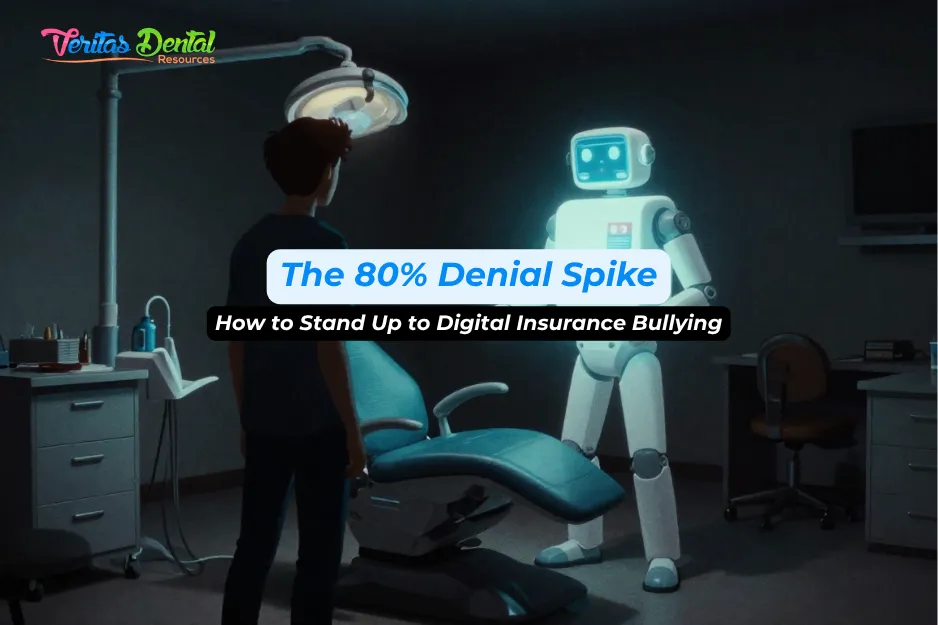
The 80% Denial Spike: How to Stand Up to Digital Insurance Bullying
You know the feeling. You’ve spent twenty minutes crafting the perfect clinical narrative. You’ve attached crystal-clear bitewings, a high-res intraoral photo, and maybe even a digital scan for good measure. You’ve basically sent the insurance company a feature-length documentary on why this patient needs a crown.
Then, three weeks later, the EOB slides across your desk like a slap in the face.
"Denied. Not medically necessary."
Your first thought? Did they even look at the X-rays?
Spoiler: They didn't. At least, a human didn't.
Welcome to the era of digital insurance bullying. We’re currently seeing what we call the "80% Denial Spike", a calculated, algorithmic wave of rejections designed to see how much "no" your practice can stomach before you simply stop asking for "yes."
The Rise of the Algorithm (Or: Why Your Clinical Expertise Is Being Ignored)
In the old days, a claim denial usually meant a human adjuster, likely someone who hadn’t touched a handpiece in twenty years, glanced at your claim and disagreed with your diagnosis. It was annoying, sure, but it was at least a person.
Today? You’re fighting a bot.
Insurance carriers have scaled their "efficiency" by implementing sophisticated AI algorithms that are programmed to find any reason, no matter how flimsy, to spit a claim back at you. These bots don't care about your patient’s oral health. They don't care about your years of clinical experience. They care about one thing: preserving the carrier's bottom line by delaying or denying payment.
When we talk about the 80% Denial Spike, we’re referring to a tactical threshold. Research shows that while denial rates hover around 15 to 20% on average, some carriers like United Healthcare have been caught pushing those numbers much higher. But here’s the kicker: data suggests that when practices actually fight back, they win up to 80% of their appeals.
The insurance companies know this. So, why do they keep denying? Because they’ve done the math. They know that less than 1% of denied claims are ever appealed. They aren't betting on being right, they’re betting on you being too tired to fight.
The "Wall of No": A Tactic of Attrition
This is digital bullying, plain and simple. The system is intentionally designed to be arduous, buried in fine print, and soul-crushingly repetitive. It’s a war of attrition.
Insurance Speak Translation:
"The information provided does not meet the criteria for the requested service based on the patient's plan limitations."
What it actually means:
"We didn't look at your narrative, our bot found a missing comma in the address field, and we're hoping you'll just bill the patient so we can keep our money for another thirty days."
The "80% Spike" isn't just about the money, it's about the psychological impact on your front office team. When your insurance coordinator sees a mountain of denials every Monday morning, burnout isn't just a possibility, it's an inevitability.
Your team starts to feel like they’re shouting into a void. Eventually, they stop writing the long narratives. They stop calling the provider lines. They start accepting the "no" as the final answer because they simply don't have the bandwidth to argue with a machine that never sleeps.
How the Bots Are Dictating Your Practice Revenue
When algorithms dictate your revenue, you’ve lost control of your business.
If you aren't actively fighting these automated rejections, you’re essentially giving the insurance carrier a "processing tax" on every single procedure. Whether it's the processing tax on virtual cards or the AI denial machine rejecting your SRPs, the goal is the same: shrink your margins until you’re working twice as hard for half the pay.
We’ve seen practices where the "Denial Spike" has caused a 15% drop in monthly collections despite a 10% increase in production. That’s a recipe for disaster. You’re doing the work, using the supplies, and paying the staff, but the bot in a server room in Connecticut decided that your patient didn't actually need that core buildup.
Standing Up to the Bully: The Veritas Angle
At Veritas Dental Resources, we’ve had enough of the bullying. We don’t just "handle insurance", we coach your team to become a formidable force that the carriers eventually learn to stop messin’ with.
We’ve developed a 7-step proven process to dismantle the 80% Denial Spike. We don’t play by the insurance company’s rules because the rules are rigged. Instead, we use their own bureaucracy against them.
Our 7-Step Shield includes:
• Algorithmic Auditing: Identifying which codes are being targeted by bots so we can front-load the documentation.
• Clinical Narrative Weaponization: We teach your team how to write narratives that the bots can't ignore. (Check out why clinical narratives are a PPO weapon).
• Documentation Mastery: Ensuring your clinical documentation is "machine-proof".
• Aggressive Appeal Tracking: We don't just appeal, we track the success rate of every single "no" we turn into a "yes."
• State Regulatory Leverage: Knowing when to threaten a complaint with the state insurance commissioner (carriers hate this).
• Team Resilience Training: Empowering your staff so they don't feel like victims of the system.
• Revenue Optimization: Reclaiming the lost percentages that the "Denial Spike" tried to steal.
Don’t Just Work Harder, Fight Smarter
If you're seeing an influx of denials, don't just assume your clinical standards have slipped. They haven't. The goalposts have just been moved by an algorithm that doesn't know a premolar from a hole in the ground.
You need to recognize that insurance doesn’t diagnose teeth, you do. When you allow a computer program to dictate what is "medically necessary," you’re giving up your authority as a doctor.
Three Things You Can Do Today:
Review Your Denial Trends: Is there a specific code (like D2740 or D4341) that is suddenly getting rejected 50% more often than it was six months ago? That’s an algorithm shift.
Stop the "Standard" Narrative: If you're copy-pasting the same three sentences for every crown, the bots have already learned how to ignore you. You need specific, data-driven narratives.
Set an Appeal Deadline: Don't let denials sit in a pile. If a claim is denied, it should be appealed within 48 hours. Persistence is the only language insurance companies understand.
The Bottom Line: Your Time Is Valuable
Your skills, your education, and your time are being dismissed by a digital script. It’s disrespectful, and it’s bad for business.
At Veritas, we believe that dental practices deserve to be paid for the work they actually perform. We’re tired of seeing great teams get "tired out" by insurance companies that hope you'll just go away.
The 80% Denial Spike is real, but it’s not invincible. It’s just a bully. And like any bully, once you punch it in the nose (metaphorically speaking, with a solid appeal and a regulatory threat), it tends to back off.
Are you ready to stop the bullying and reclaim your revenue? Let’s stop letting bots run your back office. It’s time to navigate the nonsense and ensure your practice is treated with the respect it’s earned.
Don't let an algorithm be the boss of your practice.
Book a consultation with Veritas Dental Resources today and let's start fighting back. Or, if you want to see exactly how deep the rabbit hole goes, check out our services page to see how we can optimize your entire revenue cycle.
The insurance companies have their bots. You have Veritas. Let’s see who wins.
Benjamin Tuinei
Founder – Veritas Dental Resources, LLC
📞 888-808-4513
Services: PPO Fee Negotiators, PPO Fee Negotiating, Insurance Fee Negotiating, Insurance Credentialing, Insurance Verifications
Websites: www.VeritasDentalResources.com, www.VerusDental.com


