


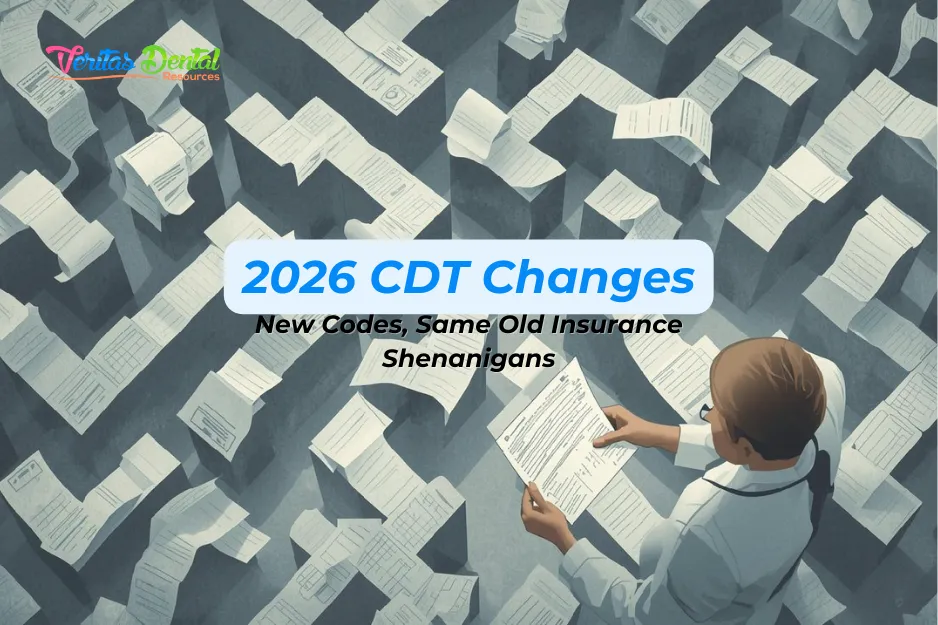
2026 CDT Changes: New Codes, Same Old Insurance Shenanigans
Every year, dentists collectively lean in when the new CDT codes are released. New codes mean progress, right? Recognition of modern dentistry. Validation that what you’re doing clinically actually exists in the real world.
And then insurance shows up like the villain in a sitcom who never gets written out of the script.
A Brief (and Painful) History Lesson
When the American Dental Association introduces new CDT codes, the intent is simple:
Define procedures clearly
Standardize communication
Allow dentists to be paid appropriately for services that actually happen
Insurance companies hear this and respond with something like:
“Oh wow, a new code? That’s adorable. We’ll add it to our policy manual, and immediately disallow it.”
Yes, add the code, define it, and then prohibit you from collecting a fee if you’re in network. It’s the insurance equivalent of saying, “Nice try. But no.”
If you’ve ever felt like insurance was patting you on the head while tightening the leash, congratulations, your instincts are working perfectly.
The Bundling Olympics Continue in 2026
Many of the 2026 CDT updates refine existing procedures, unbundle steps, or recognize adjunctive services that dentists have provided for years without compensation. Clinically? Fantastic.
Contractually? Enter the Bundling Games.
Insurance policies often respond by:
Bundling new codes into older ones
Declaring them “inclusive” or “incidental”
Labeling them “provider responsibility” (a fan favorite)
Translation: You can do the work. You just can’t get paid for it.
And if you’re in network? Your contract may already say you agreed to this, even if no one ever explained it to you.
“Why Doesn’t the ADA Fight This Harder?”
This is where frustration boils over. Many dentists feel their associations are handcuffed, and in some areas, they are. Collective fee negotiation? Off limits. That’s antitrust territory.
But here’s what can happen:
The ADA can challenge improper code interpretation
The ADA can fight insurers who redefine CDT codes incorrectly
The ADA can push back on blatant coding violations
Still, that doesn’t always help the dentist chairside on Monday morning trying to explain to a patient why a legitimate service suddenly costs $0 according to insurance.
The Real Solution (Spoiler: It’s Not Hoping Insurance Behaves)
Until the insurance industry develops a conscience (so, not soon), the best move is self advocacy.
That means:
Code Like a Pro
Use CDT codes accurately, consistently, and confidently. Sloppy coding gives insurers ammunition. Clean coding puts you in control.Demand the “Hidden” Manuals
Every insurance company has internal claims processing policies that explain exactly how they bundle, downcode, or deny procedures.
Ask for them.
Yes, they exist.
Yes, they hate sharing them.
Yes, you are entitled to them.
Read Your Contract (Really Read It)
A proper contract review often reveals an uncomfortable truth.
In network agreements are wildly one sided.
They tell you:
What you can charge
What you must write off
What you can’t bill the patient for, even if insurance pays $0
Once dentists see this in black and white, the real question becomes…
Why Participate at All?
At some point, every dentist has to ask:
“Why am I voluntarily participating in a system that treats me like a cost center instead of a professional?”
Here’s the good news:
Dropping insurance is not reckless
Out of network strategies are not unethical
Fear is not a business plan
Plenty of dentists are discovering that less insurance dependence equals more clarity, more autonomy, and often more profitability.
Take Coding Seriously, Your Future Depends on It
The 2026 CDT changes are not “just updates.” They’re another reminder that:
Coding matters
Contracts matter
Knowledge is leverage
Insurance companies aren’t bullies because they’re evil geniuses. They’re bullies because too many dentists were never given the full rulebook.
Now you know where to find it.
And once you truly understand how the game is played, you get to decide whether you want to keep playing, or finally change the rules in your favor.
Dentists deserve better. And it starts with knowing exactly what you signed up for.
Benjamin Tuinei
Founder - Veritas Dental Resources, LLC
📞 888-808-4513
Services: PPO Fee Negotiators, PPO Fee Negotiating, Insurance Fee Negotiating, Insurance Credentialing, Insurance Verifications
Websites: www.VeritasDentalResources.com, www.VerusDental.com


